
Tesla Model 3 vs Tesla Model Y: Same Platform, Different Life
Same network, same software, same DNA. The difference is how you actually use a car.

Same network, same software, same DNA. The difference is how you actually use a car.
Most car comparisons pit two brands against each other. This one is different. The Model 3 and Model Y share the same platform, the same Supercharger network, nearly identical software, and a lot of the same parts. Tesla basically built one very good thing and then asked: what does it look like optimized for a driver, versus optimized for a family?
The answer to that question is probably already sitting in how you use your car today.
 TL;DR
TL;DR
The case for the Model 3: When you strip away everything a car doesn’t need, what’s left is more focused. Lower center of gravity, better aerodynamics, sharper steering, lower price, better efficiency. The Model 3 is Tesla’s answer to the question: what does a precision instrument look like when it’s also an EV?
The case for the Model Y: A car that works for your whole life, not just the commute. More cargo, more headroom, more flexibility. The same Tesla experience, just with room to actually live in it.
This isn’t a close call if you know how you use a car. It only feels hard if you’re optimizing for the wrong thing.
The base Model 3 starts at $36,990, about $3,000 less than the base Model Y at $39,990. Combined with better efficiency, the Model 3 costs less to buy and less to run. If budget is a real variable, that compounds over time.
Both cars share Tesla’s core safety architecture, so the fundamentals are identical across the lineup.
| Safety Feature | Tesla Model 3 | Tesla Model Y |
|---|---|---|
| Front, side, curtain airbags | Standard | Standard |
| Knee airbags | Driver & front passenger | Driver & front passenger |
| Centre airbag (side-impact) | Yes | Yes |
| Pre-collision airbag deployment | Yes | Yes |
| Forward collision warning + AEB | Standard | Standard |
| Blind spot monitoring | Standard | Standard |
| Rear cross-traffic alert | Standard | Standard |
| Pedestrian / cyclist detection | Standard | Standard |
| Driver attention monitoring | Standard | Standard |
| NHTSA ADAS benchmark | N/A | First to pass (2026) |
The safety story here is consistent: both cars run Tesla Vision, both receive the same OTA safety updates, and both benefit from features like pre-collision airbag deployment that arrived after the cars shipped. Choosing between them on safety grounds isn’t the deciding factor. Choosing on how you use the car is.
| Spec | Tesla Model 3 | Tesla Model Y |
|---|---|---|
| Body style | Sedan | Compact SUV |
| Best range (EPA est.) | 363 mi (Premium RWD) | 357 mi (Premium RWD) |
| Performance range | ~309 mi (Performance AWD) | 306 mi (Performance AWD) |
| 0–60 (Performance) | ~2.9 sec | 3.3 sec |
| Efficiency | Up to 138 MPGe | Up to 134 MPGe |
| Cargo (max, seats folded, incl. frunk) | ~43 cu ft | Up to 76 cu ft |
| Rear legroom | 35.2 in | 40.5 in |
| Towing | Not rated | Up to 3,500 lbs |
| 7-seat option | No | Yes: via Model Y L (long-wheelbase), |
| Charging network | Tesla Supercharger | Tesla Supercharger |
A few worth flagging:
Range: Remarkably close at their best. Model 3 Premium RWD leads with 363 miles, Model Y Premium RWD gets 357. At the Performance trim the gap narrows to roughly 3 miles. In practice, both are more than enough for any road trip.
Cargo: This is the Model Y’s clearest win. 33.1 cu ft behind the rear seats vs. 24.1, and up to 76 cu ft with seats folded. The Model 3’s sedan trunk is a different kind of storage: fine for bags, limiting for anything bulky.
Rear legroom: 40.5 inches vs. 35.2. That extra 5 inches matters a lot if adults are sitting back there regularly, and it makes loading car seats noticeably easier.
Efficiency: The Model 3 is fractionally more efficient at up to 138 MPGe vs. 134 MPGe. Consistent with its lower, more aerodynamic profile, and it adds up over time.
The Model 3 is the more engaging car. Lower center of gravity, lighter curb weight, sharper steering. It feels more like a performance car even in standard trim, and at the Performance level, 0–60 in 2.9 seconds makes the point clearly.
The Model Y handles well for a compact SUV. Acceleration is immediate and the ride is composed. But it’s not trying to be a driver’s car, and it doesn’t pretend to be. A higher center of gravity means more body roll in fast corners. That’s physics, not a flaw.
If the drive itself matters to you, the Model 3 is the answer. If the drive is just how you get somewhere, the Model Y makes everything else easier.
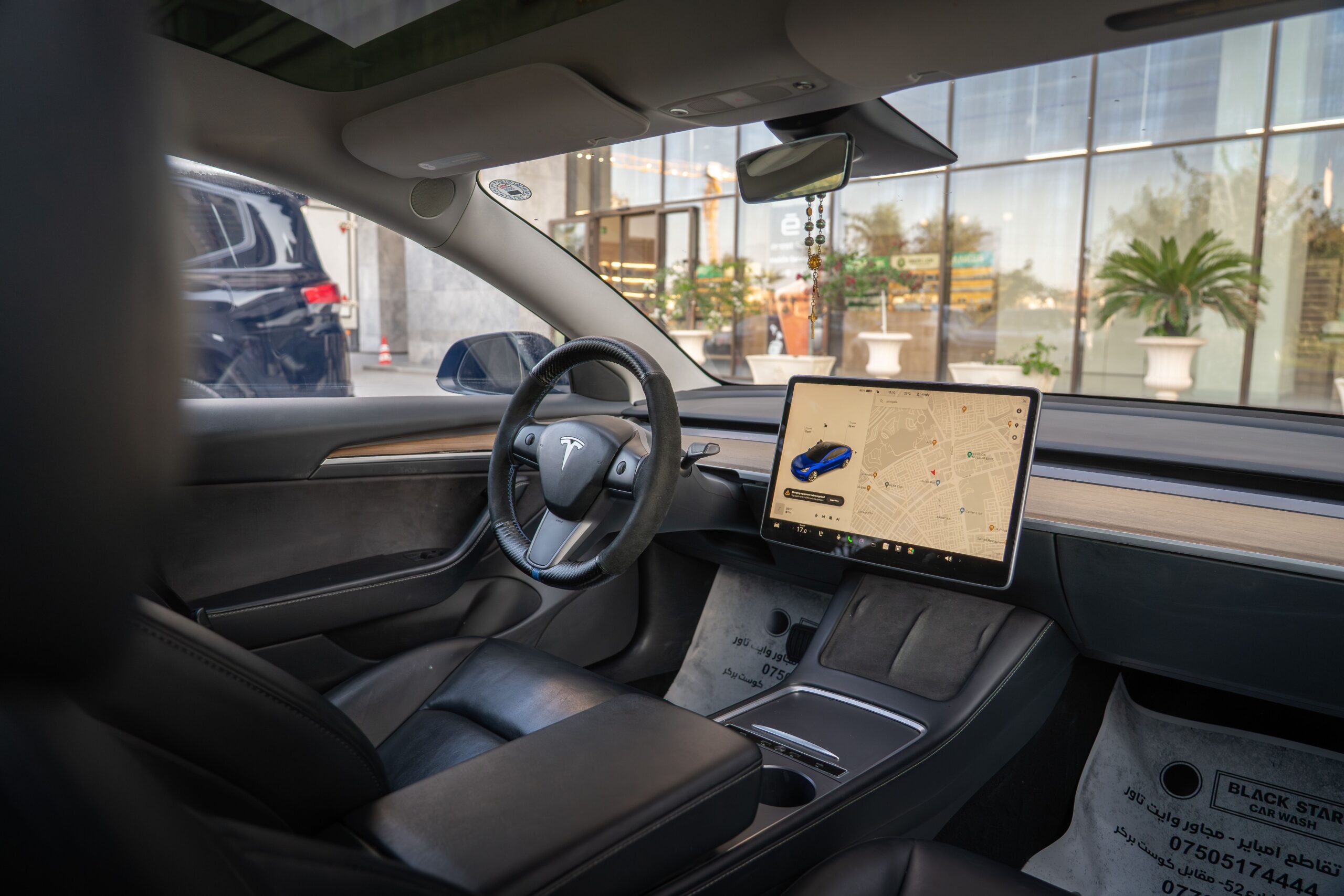
Up front, both cars feel nearly identical. Same central touchscreen, same minimalist dashboard, same software. The Tesla experience is the Tesla experience regardless of which model you’re in.
The real difference is behind the front seats. The Model Y’s higher roofline, wider door openings, and extra legroom make a genuine difference for passengers and for anyone loading car seats. Neither car supports CarPlay or Android Auto. Both receive the same OTA updates on the same cadence.
Both cars run the same software. Same FSD (Supervised) capability, same OTA update schedule, same Autopilot features, same Supercharger integration. A safety feature that ships as an OTA update arrives on both cars at the same time.
There is no software reason to choose one over the other. The decision is purely about form factor and how you use the car.
Both cars qualify for Lemonade Autonomous Car insurance (available in select states), which offers 50% off every mile driven in FSD mode. The discount is priced off Tesla’s own collision data, which shows FSD miles produce fewer incidents than human-driven ones.
If you commute daily in FSD, that difference compounds quickly. And because both models qualify, it’s not a factor in choosing between them. It’s just a reason to think carefully about how you plan to use FSD once you’ve made the call.
Buy the Model 3 if you drive mostly solo, want a more efficient and engaging car, and don’t need the extra cargo flexibility or passenger room.
Buy the Model Y if you have kids, car seats, or regularly carry more than two passengers, need to haul gear, or want the option to tow up to 3,500 lbs.
The software is the same. The network is the same. The safety architecture is the same. What you’re really choosing is the shape of your daily life, then make sure the insurance keeps up with it.
No. Both run the same FSD (Supervised) software, receive the same OTA updates, and qualify for the same Lemonade insurance discount (available in select states). The software experience is identical.
No meaningful difference. Both use the same battery technology and thermal management system.
You need a Tesla with Hardware 4.0, FSD availability in your state, and to connect your Tesla directly to your Lemonade policy (with your permission). The discount applies to every mile driven in FSD mode and covers both the Model 3 and Model Y.
A few quick words, because we <3 our lawyers: This post is general in nature, and any statement in it doesn’t alter the terms, conditions, exclusions, or limitations of the policies issued, which differ according to your state of residence. You’re encouraged to discuss your specific circumstances with your own professional advisors. The purpose of this post is merely to provide you with info and insights you can use to make such discussions more productive! Naturally, all comments by, or references to, third parties represent their own views, and Lemonade assumes no responsibility for them. Coverage may not be available in all states. Please note that statements about coverages, policy management, claims processes, Giveback, and customer support apply to policies underwritten by Lemonade Insurance Company or Metromile Insurance Company, a Lemonade company, sold by Lemonade Insurance Agency, LLC. The statements do not apply to policies underwritten by other carriers.
Please note: Lemonade articles and other editorial content are meant for educational purposes only, and should not be relied upon instead of professional legal, insurance or financial advice. The content of these educational articles does not alter the terms, conditions, exclusions, or limitations of policies issued by Lemonade, which differ according to your state of residence. While we regularly review previously published content to ensure it is accurate and up-to-date, there may be instances in which legal conditions or policy details have changed since publication. Any hypothetical examples used in Lemonade editorial content are purely expositional. Hypothetical examples do not alter or bind Lemonade to any application of your insurance policy to the particular facts and circumstances of any actual claim.