

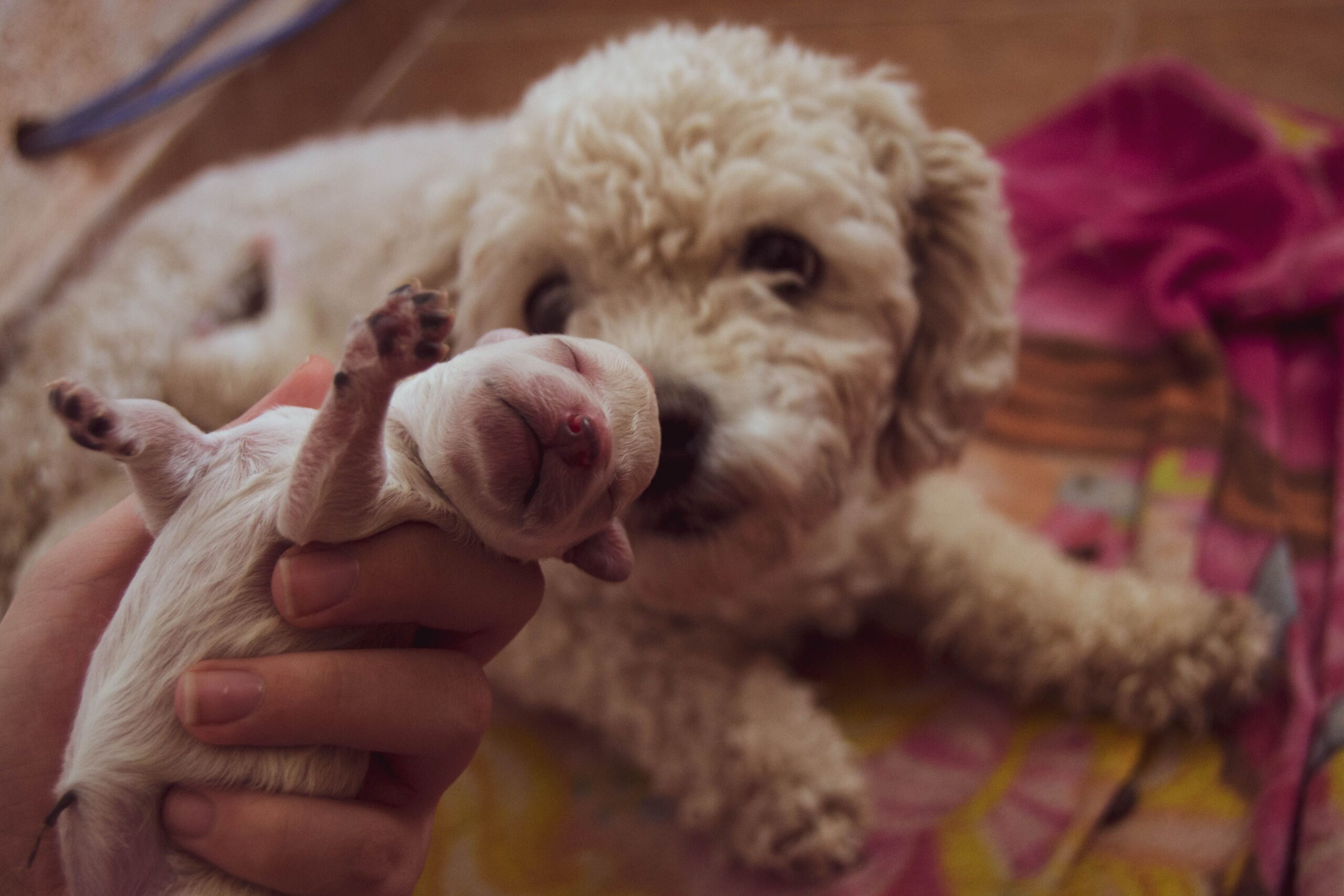
- Signs your dog is going into labor soon
- Is this labor? How to tell, and how urgent is it?
- How long does dog labor last?
- What to do while your dog is giving birth
- Emergency signs during dog labor: when to call the vet
- Setting up a whelping box at home
- After the birth: post-whelping care
- Dystocia in dogs: when labor doesn't go as planned
- What about pet insurance and dog pregnancy?
- Before we go
If your dog is pregnant and the due date is getting close, it’s completely normal to feel a mix of excitement and nerves, especially if this is your first time going through it. Knowing what to expect, what’s normal, and what’s a genuine emergency can make the whole experience a lot less stressful for both of you.
This guide walks you through every stage of dog labor: the early signs that birth is coming, what happens during delivery, what you can do to help, and when it’s time to call the vet.
 TL;DR
TL;DR
- Dog pregnancy lasts 57 to 72 days (average: 63). A temperature drop below 100°F is the most reliable sign labor is 12 to 24 hours away.
- Labor has three stages. Stage 1 is early contractions with no puppies yet (6 to 12 hours). Stage 2 is active delivery. Stage 3 is placenta delivery, which overlaps with Stage 2.
- Between puppies, up to 2 hours of rest is normal as long as your dog isn’t actively straining.
- Most labors go smoothly, but know the emergency signs before the due date. Complications move fast.
- Lemonade Pet does not cover pregnancy, whelping, or breeding-related complications. If you’re planning to breed, those costs are yours to budget for separately.
Signs your dog is going into labor soon
Dog pregnancy lasts about 57 to 72 days, with 63 days being the average. As that window approaches, your dog’s body starts sending clear signals that labor is close. Here’s what to watch for in the days and hours leading up to delivery.
Nesting behavior
A day or two before labor, many dogs start looking for a quiet, secluded spot to settle into. She might scratch at bedding, circle obsessively, or try to hide in closets or under furniture. This is her instinct telling her to find a safe place for her puppies. If you’ve set up a whelping box (more on that below), this is a good time to encourage her to spend time in it.
Appetite changes
Most dogs stop eating in the 24 hours before labor begins. Some will refuse food entirely. If your dog skips a meal and you’re in that final week of pregnancy, pay attention – it’s often one of the first signs things are getting close.
The temperature drop: the most reliable signal
This one is worth taking seriously. A dog’s normal body temperature is between 101°F and 102.5°F. About 12 to 24 hours before labor begins, that temperature drops below 100°F. Some dogs drop as low as 98°F.
Starting about a week before her due date, take your dog’s rectal temperature twice a day and write it down. When you see that drop, you’ll know labor is likely just hours away. Your vet can walk you through how to do this if you haven’t before, and it’s worth asking at your pre-birth checkup.
Physical changes
In the days before birth, you may also notice:
- Nipples becoming enlarged and possibly leaking milk
- The belly visibly dropping as the puppies shift into position
- Vaginal discharge that’s clear or slightly cloudy (this is normal)
- Restlessness, panting, or shivering even when she’s not cold
- Increased clinginess or, conversely, wanting to be completely alone
Is this labor? How to tell, and how urgent is it?
If you’re not sure whether what you’re seeing is early labor or just late-pregnancy restlessness, here’s a quick guide:
Probably early labor – watch closely, no need to panic yet:
- She’s restless, panting, or nesting but temperature hasn’t dropped yet
- She’s off her food and a little unsettled
- Temperature has just dropped below 100°F for the first time
Labor is underway, stay with her:
- Temperature dropped 12 to 24 hours ago and she’s now visibly uncomfortable
- Strong abdominal straining has started
- You can see or feel a puppy moving toward the birth canal
Call your vet now:
- Strong straining for 20 to 30 minutes with no puppy delivered
- More than 2 hours between puppies while she’s still restless or straining
- She’s been in Stage 1 labor for more than 24 hours with no active delivery
- Green or black discharge before any puppies have arrived
- Any foul-smelling vaginal discharge
- A puppy is partially visible but not progressing
Go to emergency care immediately:
- Muscle tremors, stiffness, wobbly walk, or seizures (signs of eclampsia, a dangerous drop in calcium)
- A puppy is stuck and not moving despite prolonged straining
- Your dog collapses or loses consciousness
- Extreme distress or signs of severe pain
When in doubt, call. Vets would always rather answer a question than get an emergency call an hour too late.
The three stages of dog labor
Understanding the stages of dog labor helps you know where you are in the process and when something’s outside the normal range. Here’s how it unfolds.
Stage 1: Early labor (contractions begin, no puppies yet)
Stage 1 typically lasts 6 to 12 hours, though it can stretch up to 24 hours in first-time mothers. During this phase, the cervix (the opening between the uterus and the birth canal) starts to dilate, or widen, to allow puppies to pass through. You won’t see puppies yet, but you will see behavioral changes.
What you’ll notice:
- Panting, trembling, or shivering
- Restlessness and pacing
- Repeated vomiting or retching in some dogs
- Nesting and digging intensifying
- She may want you close by, or she may want to be left alone
Contractions are happening internally at this stage, so you won’t necessarily see visible abdominal straining yet. This can make Stage 1 feel uncertain. Trust the signals above and keep an eye on the clock.
Stage 2: Active delivery (puppies arriving)
Stage 2 is when puppies are actually born. You’ll see visible, strong abdominal contractions now – your dog will strain noticeably with each push. The first puppy typically arrives within 1 to 2 hours of strong active straining beginning.
Each puppy is born inside an amniotic sac – a thin, fluid-filled membrane that looks a bit like a transparent bag. Mom will usually break this sac herself immediately after birth, then lick and nuzzle the puppy vigorously. That stimulation is important: it clears the airways and encourages the newborn to breathe and move.
Puppies can be born head-first or tail-first. Both are normal. Between puppies, your dog may rest for anywhere from a few minutes to about 2 hours. That rest period is within the normal range, as long as she isn’t straining continuously during it.
Stage 3: Placenta delivery
Stage 3 overlaps with Stage 2. After each puppy is born, the placenta (the organ that nourished the puppy in the womb) is delivered, usually within 5 to 15 minutes. There should be one placenta per puppy.
Keep count. A retained placenta – one that stays inside the uterus instead of being expelled – can cause a serious infection. If the number of placentas doesn’t match the number of puppies, call your vet.
Mom may eat the placentas. This is completely normal instinctive behavior, though letting her eat too many can cause digestive upset. One or two is usually fine.
How long does dog labor last?
The full whelping process (the delivery of an entire litter) can take anywhere from a couple of hours to over 24 hours, depending on litter size and the individual dog. Here’s a rough breakdown:
- Stage 1 (early labor): 6 to 12 hours, sometimes up to 24 hours
- Between puppies: a few minutes to 2 hours is normal
- Full litter delivery: anywhere from 1 hour for small litters to 24+ hours for larger ones
First-time mothers often take longer than experienced mothers. Large-breed dogs and brachycephalic breeds (flat-faced dogs like French Bulldogs and Bulldogs) are more likely to have longer or complicated labors. If your dog is one of these breeds, talk to your vet before the due date about having a plan in place, including the possibility of a cesarean section (a surgical delivery).
What to do while your dog is giving birth
Your main job during labor is to stay calm, stay present, and intervene only when necessary. Most dogs handle delivery instinctively. Here’s how to support her without overstepping.
If mom doesn’t break the amniotic sac
Sometimes, especially in first-time mothers, a dog won’t immediately tend to a newborn. If the puppy is still inside the amniotic sac and mom isn’t moving to break it, you need to act quickly – within a minute or two. Carefully tear the sac open with your fingers, starting at the face, and use a clean towel to wipe the fluid from the puppy’s nose and mouth. Then rub the puppy firmly with the towel to stimulate breathing and circulation. The puppy should start wriggling and crying. If it doesn’t, keep rubbing vigorously.
Umbilical cord
Mom will usually chew through the umbilical cord (the cord connecting the puppy to the placenta) herself. If she doesn’t, tie off the cord with dental floss about an inch from the puppy’s belly and use clean scissors to cut on the placenta side of the tie. Don’t pull on the cord.
Keep newborns warm and nursing
Newborn puppies can’t regulate their own body temperature. The whelping area should stay around 85°F for the first week. As each puppy is born and cleaned, gently move it toward mom so it can start nursing. That first milk (called colostrum) is packed with antibodies that protect the puppies from infection in their first weeks of life.
While mom is still in active labor, you can keep already-born puppies in a small box with a warm water bottle wrapped in a towel, just close enough that mom can see and smell them.
Emergency signs during dog labor: when to call the vet
This is the section to read carefully. Most labors go smoothly, but complications do happen, and acting quickly can save lives. Have your vet’s number and the nearest emergency animal hospital’s number written down before the due date.
Call your vet immediately if you see any of the following:
- Strong, active straining for 20 to 30 minutes with no puppy delivered. This could mean a puppy is stuck in the birth canal, a condition called dystocia (difficult birth). This is a genuine emergency.
- More than 2 hours between puppies while your dog is still visibly straining or restless and you know more puppies are still inside.
- Your dog has been in Stage 1 labor for more than 24 hours without moving into active delivery.
- Green or black discharge before any puppies have been born. A small amount of dark green discharge during or after delivery can be normal (it’s a pigment from the placentas), but green discharge with no puppy delivered first is a warning sign that a placenta has separated early.
- Foul-smelling vaginal discharge, which can signal infection.
- Signs of hypocalcemia (dangerously low calcium), which can happen in nursing mothers: muscle tremors, stiffness, a wobbly walk, or seizures. This is called eclampsia or milk fever and requires immediate veterinary treatment.
- Mom loses interest in her puppies, refuses to nurse, or seems confused, lethargic, or in extreme pain after delivery.
- Retained placenta – if the number of placentas doesn’t match the number of puppies, there may be one still inside. Left untreated, this can lead to a serious uterine infection.
- A puppy is partially visible but not progressing after several minutes of straining. Do not attempt to pull the puppy yourself. Call the vet.
When in doubt, call. Vets would always rather answer a question than get an emergency call an hour too late.
Setting up a whelping box at home
A whelping box is a dedicated, enclosed space where your dog can give birth and nurse her puppies safely. Set it up 1 to 2 weeks before the due date so she has time to get comfortable with it before labor begins.
What makes a good whelping box
- Size: large enough for mom to stretch out fully, with room for a litter of puppies, but not so large that puppies can get lost or cold in the corners
- Low sides on one side so mom can step in and out easily, but high enough to keep puppies contained
- Pig rails (or safety rails): a ledge around the inner perimeter that prevents mom from accidentally lying on a puppy against the wall
- Easy-to-clean lining: newspaper or waterproof pads work well, covered with a soft layer of towels or fleece
- Warmth: a heat lamp or heating pad on one side (never the whole surface, so puppies can move away if too warm)
Supplies to have ready
- Clean towels (several – you’ll use more than you think)
- Clean scissors and unwaxed dental floss (for the umbilical cord if needed)
- A bulb syringe to gently clear a puppy’s airway if needed
- A digital rectal thermometer (for monitoring mom’s temperature pre-labor)
- A small kitchen scale to weigh puppies after birth
- A notebook or app to track birth times, puppy weights, and placenta count
- A heat source for the whelping area
- Your vet’s number and the nearest emergency vet’s number
After the birth: post-whelping care
Once all the puppies have arrived and placentas have been accounted for, the work isn’t quite done. Here’s what the first few days look like.
Monitoring mom
After delivery, it’s normal for your dog to have a vaginal discharge called lochia (pronounced LOH-kee-uh). This is a reddish-brown discharge that gradually fades over about three weeks. It should not smell foul. If it does, or if it turns bright red and heavy, that’s a vet call.
Watch for signs of infection in the days following birth: fever, loss of appetite, lethargy, swollen or painful mammary glands (the breast tissue that produces milk), or any change in her milk. Mastitis – an infection of the mammary glands – and metritis – a uterine infection – are both serious and need prompt treatment.
It’s a good idea to schedule a post-birth vet checkup within 24 to 48 hours of delivery to make sure mom is healthy and all puppies are accounted for.
Newborn puppy care
Newborn puppies are helpless. They can’t see, hear, or regulate their own temperature. For the first few weeks, their entire world is warmth, milk, and sleep. Here’s what to watch for:
- Every puppy should nurse within the first few hours. If one is being pushed aside or isn’t latching, you may need to help guide it to a nipple.
- Weigh puppies daily for the first two weeks. They should gain weight steadily. A puppy losing weight or not gaining is a warning sign.
- Keep the whelping area at around 85°F for the first week, then gradually reduce to about 80°F in week two.
- Watch for “fading puppy syndrome” – a term for puppies that are weak, not nursing, crying constantly, or losing weight in the first two weeks. This requires immediate vet attention.
Dystocia in dogs: when labor doesn’t go as planned
Dystocia is the medical term for difficult or obstructed birth. It’s one of the most serious complications that can occur during the whelping process, and it’s more common in certain breeds.
Flat-faced breeds (French Bulldogs, English Bulldogs, Boston Terriers, Pugs) have notoriously high rates of dystocia because of the mismatch between puppy head size and the mother’s birth canal. Many of these dogs require a planned cesarean section rather than a natural birth. If you have one of these breeds, talk to your vet early in the pregnancy about whether a surgical delivery is recommended.
Other risk factors for dystocia include:
- Very small litter sizes (sometimes a single large puppy is harder to deliver than several smaller ones)
- Very large litters that exhaust the mother before all puppies are delivered
- Uterine inertia – when the uterus stops contracting effectively during labor
- Abnormal puppy positioning in the birth canal
- First-time mothers
- Older mothers
If your dog is straining hard without results or seems to be in extreme distress, don’t wait. This is an emergency.
What about pet insurance and dog pregnancy?
This is worth being upfront about: Lemonade Pet does not cover pregnancy, whelping, or complications that arise from breeding or the birthing process. That includes costs related to dystocia, cesarean sections for whelping, retained placentas, or eclampsia (low calcium in nursing mothers). If you’re planning to breed your dog, those costs are yours to plan for out of pocket.
What Lemonade Pet does cover is accidents and illnesses that aren’t related to pregnancy. So if your dog needs treatment for an unrelated condition during or after her pregnancy, or if she gets sick or injured independently of the whelping process, that coverage can still apply. And once the puppies are weaned and you’re thinking about getting them covered, Lemonade offers pet insurance for dogs and cats that covers eligible accidents, illnesses, and more.
Before we go
Watching your dog give birth is remarkable, and a little terrifying if you don’t know what to expect. The best thing you can do is prepare early: get the whelping box set up, track her temperature in that final week, save your vet’s out-of-hours number somewhere easy to find at 2am, and read through the emergency signs above so they’re familiar if you need them.
Most labors go well. Most puppies arrive healthy. Your dog’s instincts are strong, and your job is mostly to stay calm, stay present, and know when to call for backup.
A few quick words, because we <3 our lawyers: This post is general in nature, and any statement in it doesn’t alter the terms, conditions, exclusions, or limitations of the policies issued, which differ according to your state of residence. You’re encouraged to discuss your specific circumstances with your own professional advisors. The purpose of this post is merely to provide you with info and insights you can use to make such discussions more productive! Naturally, all comments by, or references to, third parties represent their own views, and Lemonade assumes no responsibility for them. Coverage may not be available in all states. Please note that statements about coverages, policy management, claims processes, Giveback, and customer support apply to policies underwritten by Lemonade Insurance Company or Metromile Insurance Company, a Lemonade company, sold by Lemonade Insurance Agency, LLC. The statements do not apply to policies underwritten by other carriers.