Moving to Honolulu, HI: A Renter's Real Guide
The practical realities a renter actually needs to know before settling into Honolulu.


The practical realities a renter actually needs to know before settling into Honolulu.
You’ve signed the lease. Before you book the container, here’s what no listing tells you: how much cash you need at signing, why a short drive can take an hour, and what standard renters insurance doesn’t cover.
Here’s everything else you need to know about moving to Honolulu.
 TL;DR
Honolulu is Hawaii’s biggest city, and it’s compact. You get beaches, mountains, and a real downtown within a few miles of each other. You also get small apartments, steep prices, and no way to drive off the island when you need a change of scenery.
Space is the first adjustment. A typical one-bedroom is about 587 square feet. Rent is still climbing. The citywide average rose 6.09% compared to the previous year.
Neighborhoods feel very different from each other. Waikiki is busy and tourist-heavy. Kakaako and Ala Moana have newer high-rises. Kaimuki and Manoa feel residential. Pearl City and Aiea sit west of town and lean on the freeway.
The military presence is real, and it keeps rental demand steady. Joint Base Pearl Harbor-Hickam and Schofield Barracks anchor a big part of the market.
Honolulu drivers average just 17.8 miles per hour, and spend an estimated 88 hours a year sitting in traffic. That’s a good reason to test your commute before you sign.
You’ll probably want a car. TheBus runs across the island, and Skyline rail is useful on its route. But for most renters, the daily routine still involves driving.
| Option | What it covers | Fare | Best for |
|---|---|---|---|
| TheBus | Routes across Oahu | $3 with a HOLO card, $3.25 in cash | Errands and commutes along main routes |
| Skyline rail | West Oahu toward town, including the airport area | $3 with a HOLO card, no cash accepted | West side commuters |
| Car or rideshare | Everywhere else | Varies | Most neighborhoods |
If you’re renting in Waikiki, Kakaako, or Downtown, you may be able to skip the car for daily errands. Outside those areas, don’t count on it.
Honolulu’s weather is gentle most of the year. But it’s tropical, coastal, and remote, so a few risks deserve a spot on your checklist before you sign.
| Hazard / season | What to expect | What to do |
|---|---|---|
| Hurricanes (June to November) | Strong wind, heavy rain, power outages | Stock a 14-day kit. Read your policy’s storm and wind terms. Track storms. |
| Flooding and flash floods (year-round) | Fast-rising water in heavy rain | Check your building’s risk on FEMA’s Flood Map Service Center. Standard renters insurance doesn’t cover it. |
| Tsunami and high surf (coastal areas) | Sudden evacuation orders | Find your evacuation zone before you sign. |
| Wildfire (dry, leeward areas) | Fast-moving fire, heavy smoke | Know your evacuation route and keep a go-bag by the door. Standard renters insurance covers fire and smoke damage. |
| Earthquakes (year-round) | Rare, but possible | Standard renters insurance doesn’t cover them. |
Honolulu is one of the pricier rental markets in the country, and the cash you need at signing adds up fast.
| Cost | Typical amount | Notes |
|---|---|---|
| First month’s rent | About $2,356 (one-bedroom average) | Due at signing |
| Security deposit | Up to one month’s rent | State law caps it at one month |
| Pet deposit | Up to one more month’s rent | Only if the lease allows pets. Ask for the amount in writing. |
| Other move-in fees | Generally not allowed (HRS § 521-44). Push back if asked. | Hawaii’s rental code says landlords can’t collect other money at the start of a rental agreement. |
| Renters insurance | $10 to $15 a month | Based on Lemonade internal data for Honolulu |
Example: On a $2,356 one-bedroom, that’s $2,356 for the deposit plus $2,356 for first month’s rent. You’d owe $4,712 at signing, before any pet deposit.
As of 2026, Lemonade renters insurance in Honolulu averages around $10 to $15 a month – less than a streaming subscription for coverage that actually matters (Based on Lemonade internal data, 2026).
Honolulu renters are covered by Hawaii’s landlord-tenant law (HRS Chapter 521). It gives you a deposit cap, entry notice, a repair process, and protection from retaliation. Here’s what matters most.
This isn’t legal advice. If your situation is tricky, check the statute or talk to a local expert.
Send repair requests by text or email and keep screenshots. Even if your landlord does a move-in checklist, film your own. Your 14-day deposit return window comes down to what you can prove.
Registering your car and getting your license are two separate steps. Your car and your license run on separate clocks.
The 30-day clock for your car starts when it arrives in the state, not when you find a place to live. Another source counts from the day you establish residency, so start early to be safe. A car shipped from the mainland can take 2 to 4 weeks at sea, which leaves little time once it arrives.
Hawaii also requires a safety inspection, and for a newly arrived car it comes before registration. Each county runs its own motor vehicle office, so check with the City and County of Honolulu for appointments and fees.
| Task | Deadline after moving | Where to do it |
|---|---|---|
| Car registration | 30 days from arrival in Honolulu | Your county motor vehicle office |
| Driver’s license (if you drive) | 30 days from establishing residency | Your county driver licensing office |
| Safety inspection | Before registration | Authorized inspection station |
| Auto insurance | Before registration (required) | A Hawaii-licensed insurer |
| Voter registration | Before the next election (same-day registration available) | Online or in person at a voter service center |
Moving to Honolulu from another state? Read our complete Hawaii Relocation Guide for car registration deadlines, state tax rules, and statewide tenant laws.
Set up USPS mail forwarding before you move. Then work through the rest: your employer, bank, IRS, and subscriptions.
Hawaii has a state income tax, so file a return if it applies to you. Also check whether your previous state wants a partial-year return. If you already have a renters insurance policy, here’s how to change your address on renters insurance when you cross a state line.
Honolulu votes by mail, so once you’re signed up, your ballot lands in your mailbox. The quickest route is online at olvr.hawaii.gov once you have your Hawaii license or state ID. You can also sign up while you apply for either one at your county office.
Moving to Honolulu from another state? You’ll need to cancel your old renters policy and start a new Hawaii one, and update your address. Time the new policy to start the day the old one ends, so you’re never uncovered, not even for a night.
Moves to Honolulu usually mean shipping by container or barge, or flying with a limited baggage allowance. Book early. Before moving day, run through a moving checklist and check what moving insurance actually covers, and if you’ve never done a long-distance move before, how to pack like a pro will save you a headache or two.
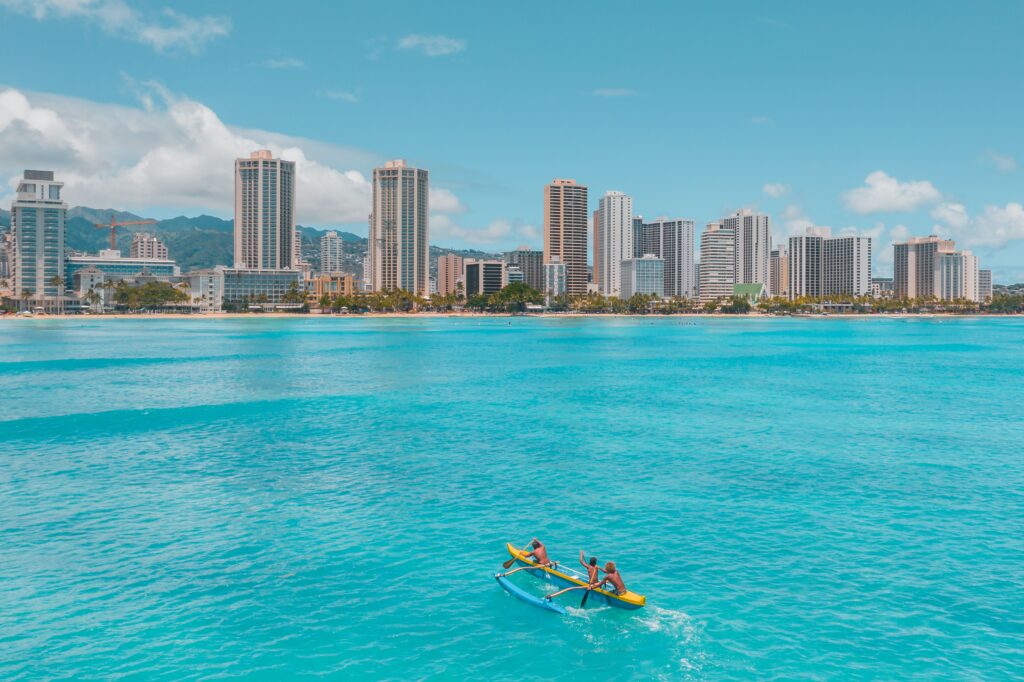
Oahu’s neighborhoods feel very different from one another. Here’s a practical breakdown by lifestyle fit.
| Neighborhood / Area | Character & vibe | Best for |
|---|---|---|
| Waikiki | Tourist-heavy, beachfront, lots of small apartments and condos | People who want the beach out the front door and don’t mind the crowds |
| Kakaʻako and Ala Moana | High-rise living, walkable to shops and the waterfront | Professionals who want urban density |
| Mōʻiliʻili and Mānoa | Near the University of Hawaii, with a student-friendly mix of rentals | Students, staff, and anyone who wants a quieter, greener pocket close to town |
| Kaimuki and Kapahulu | Neighborhood feel, local restaurants, older homes and small buildings | People who want a lived-in community close to Waikiki |
| Kailua and the Windward side | Beachy and family-friendly, across the mountains from town | Families and beach lovers who don’t mind a commute |
| Pearl City, Aiea, and Kapolei | Suburban, with more space and a longer drive into town | Families, military households, and anyone who wants more room |
Honolulu rewards planning, especially around money, space, and community.
Moving to Honolulu as a renter means learning a short list of rules fast. Deposits are capped at one month and returned within 14 days. You have 30 days to sort out your car and license. Island prices, including electricity, will shape your real budget. Flood and earthquake risks come with the territory, and standard renters insurance won’t cover either.
Get your renters insurance active, read your lease, and document your move-in condition on day one.
Ready to get covered before the moving container arrives? Lemonade renters insurance takes as little as 90 seconds to set up.
It depends on your neighborhood. Central Honolulu can work with buses and Skyline rail, but most of Oahu is easier with a car. Ask how far your unit is from work and groceries.
State law doesn’t require it, but your landlord might. It’s worth having either way, since it covers your belongings and your liability.
No. Standard renters insurance doesn’t cover either one. Ask about add-on coverage before you sign your lease.
You have 30 days from establishing residency to convert a valid out-of-state license. Appointments can book up, so start early.
Yes. Honolulu averages about $2,160 a month, and a typical one-bedroom is only about 587 square feet. Groceries and electricity cost more than on the mainland too.
Yes. Honolulu is a city in a US state, so a move there is legally no different from relocating anywhere else in the country. No visa, permit, or immigration process applies.
A few quick words, because we <3 our lawyers: This post is general in nature, and any statement in it doesn’t alter the terms, conditions, exclusions, or limitations of the policies issued, which differ according to your state of residence. You’re encouraged to discuss your specific circumstances with your own professional advisors. The purpose of this post is merely to provide you with info and insights you can use to make such discussions more productive! Naturally, all comments by, or references to, third parties represent their own views, and Lemonade assumes no responsibility for them. Coverage may not be available in all states. Please note that statements about coverages, policy management, claims processes, Giveback, and customer support apply to policies underwritten by Lemonade Insurance Company or Metromile Insurance Company, a Lemonade company, sold by Lemonade Insurance Agency, LLC. The statements do not apply to policies underwritten by other carriers.
Please note: Lemonade articles and other editorial content are meant for educational purposes only, and should not be relied upon instead of professional legal, insurance or financial advice. The content of these educational articles does not alter the terms, conditions, exclusions, or limitations of policies issued by Lemonade, which differ according to your state of residence. While we regularly review previously published content to ensure it is accurate and up-to-date, there may be instances in which legal conditions or policy details have changed since publication. Any hypothetical examples used in Lemonade editorial content are purely expositional. Hypothetical examples do not alter or bind Lemonade to any application of your insurance policy to the particular facts and circumstances of any actual claim.