
What Is Homeowners Insurance and How Does It Work?
Get your home covered, from roof to shed.

Get your home covered, from roof to shed.
Your home is one of your most valuable assets-so it makes sense that you’d want to keep it well-protected. That’s where the right homeowners insurance policy comes in.
You probably know that in exchange for paying a monthly or yearly premium, homeowners insurance protects your home against covered losses. But you may not be familiar with the intricacies of homeowners insurance because, let’s face it, most of us don’t spend our spare time talking insurance. So let’s take a closer look at how it works.

A home insurance policy is an agreement between you and your insurance company. You pay a monthly premium, and in exchange, the insurer offers you financial protection in the event that there’s damage due to a covered “peril.” There are a few different types of homeowners insurance, with Lemonade offering HO3 and HO6 (condo) policies.
A standard HO3 policy can cover the costs of repairing damage from “perils” like fire, lightning, windstorms, hail, smoke, theft, and vandalism.
Homeowners insurance doesn’t just apply to the physical structure of your house. It also covers your belongings-from your bicycle to your laptop-even when you’re not at home. It also has your back in the case of accidents on your property which might lead to legal action.
A general rule: When you read your policy, pay close attention to the exclusions from coverage and to the conditions you must satisfy to get coverage.
We’ll break down all the things homeowners insurance covers in just a sec.
The main reason to get Lemonade homeowners insurance is well, because you probably have to.
When you take out a mortgage, a lender or a bank lend you a large amount of money to cover the price of a home, with the expectation that you, the homeowner, pay back this loan with interest. If your home was damaged and you didn’t have insurance (or the funds for the repairs), you might default on your loan, the property would go down in value, and the lender would take a big loss on their investment. Yikes.
But beyond being required, a homeowners insurance policy is just common sense. The right coverage can protect your wallet if you run into a bit of bad luck, like if a tree falls on your roof, or if someone slips on your patio and breaks their ankle and ends up in the ER.
Here’s a closer look at what’s covered by your standard homeowners insurance policy:
Dwelling coverage (Coverage A) is the centerpiece of a homeowners insurance policy. If your physical home is damaged or destroyed, dwelling coverage could help cover the costs to repair or even rebuild it.
Naturally, there will also be some exclusions to what’s covered by your dwelling coverage, which you’ll see listed out in your policy. For example, it’s common for things like damage caused from flooding, mold, and earthquakes to not be covered by your policy. (You’d generally want to secure separate insurance policies to cover floods and earthquakes.)
Referred to as ‘Other Structures’ coverage, or Coverage B, this part of your policy covers assets on your property that aren’t connected to your home or built into your property’s foundation.
This coverage includes your driveway, fence, toolshed, aboveground or in-ground pool, or detached driveway. Basically, if it’s not attached to your home, didn’t sprout from the ground, and is a part of your property-it’s covered under Coverage B.
Personal property coverage (Coverage C) protects your belongings from certain named perils. Anything from your Peloton to your laptop or living room couch would fall under Coverage C. Keep in mind, however, that you won’t be able to file a claim if those things just stop working-if your MacBook dies, that’s between you and Apple. But if your MacBook is damaged in a fire, or is stolen, your Lemonade homeowners insurance comes into play.
Coverage C also travels with you when you leave the house. If you lock your bike in front of a local coffee shop and someone blasts through the chain, you’d be able to file a claim for the theft.
If unexpected damages force you out of your place for a period of time, your Loss of Use coverage (Coverage D) comes into effect to cover the additional costs connected to temporarily living outside of your home.
Coverage D will help foot additional expenses related to hotel lodging, takeout, laundry, and parking-above and beyond what you’d normally pay if you were in your home.
It’s important to note that certain situations won’t make you eligible for Loss of Use on their own. For instance, if you lose power, or your pipes freeze-without any additional damage to your property-this would not be sufficient to activate Loss of Use coverage.
Personal Liability coverage (Coverage E) defends you in scenarios where you might be legally vulnerable. For instance:
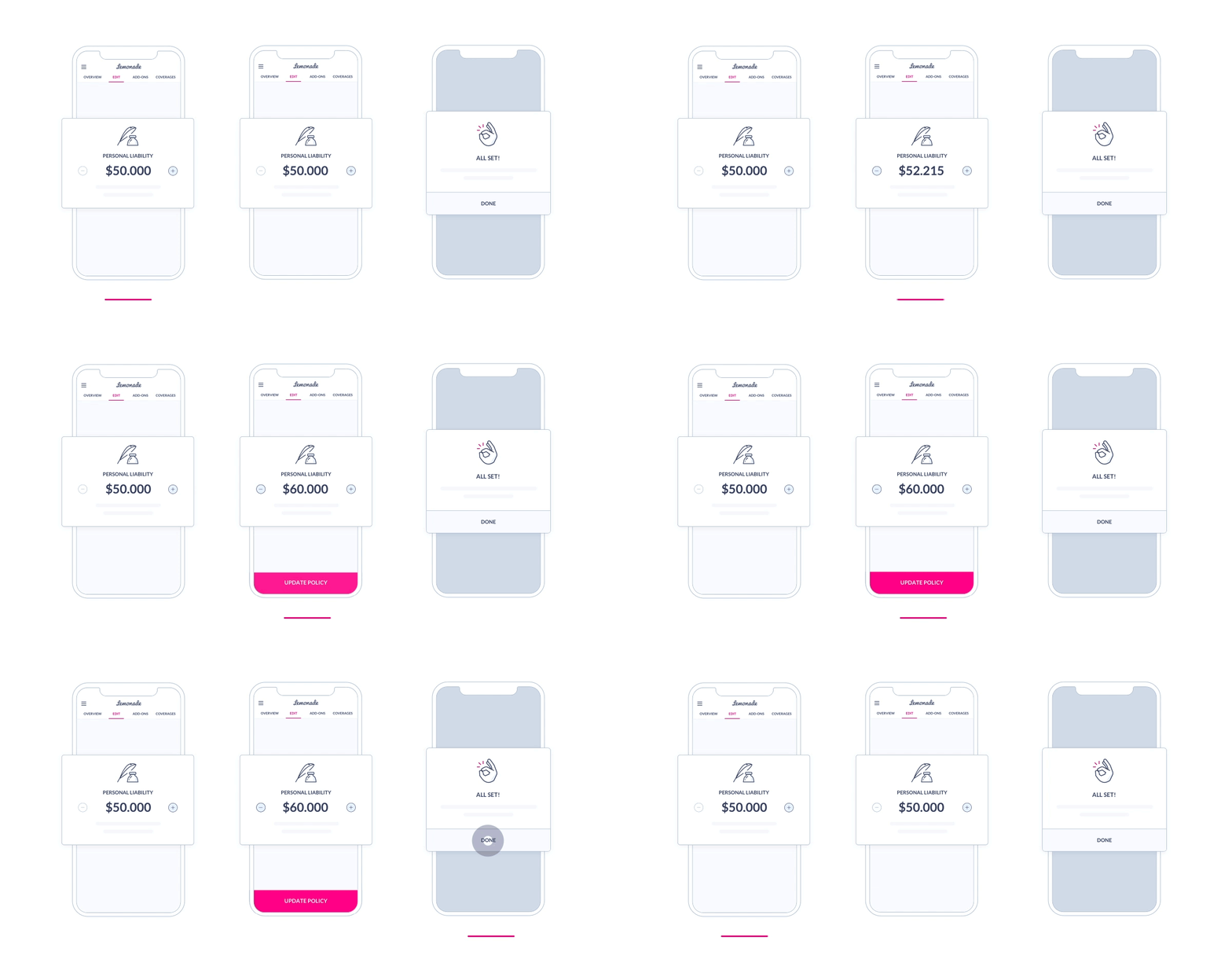
You’re having a party. After one too many pints of Moral Hazard IPA, a guest slips, falls, and breaks their ankle on your patio. Their medical bill comes to $2,000. In this case, your Medical Payments Coverage (Coverage F) will help foot the bill (pun intended).
This part of your policy helps cover medical bills up to $5,000 for guests on your property, whether or not you’re liable for what caused them to be injured.
Medical bills in excess of $5,000 might be covered by your personal liability coverage (Coverage E, discussed above).
Knowing what’s covered is one thing. Seeing it in action is another. Here are five real-world scenarios that show exactly how your Lemonade homeowners policy responds when things go sideways – which coverages kick in, what the claim process looks like, and what you’d actually walk away with.
Situation: Jamie was frying chicken when a grease splatter hit the burner. Flames shot up the backsplash and caught the cabinets. By the time the fire was out, the kitchen walls, cabinetry, countertops, and two appliances were destroyed – with smoke damage spreading into the dining room.
Coverage decision: Covered.
Reasoning: Fire is a covered peril under a standard HO3 policy. Structural damage to the kitchen falls under Coverage A (Dwelling), the destroyed appliances fall under Coverage C (Personal Property), and the three weeks Jamie spent eating takeout while repairs were underway triggered Coverage D (Loss of Use). Multiple coverages worked together to handle one event.
Outcome: Structural repairs came to $28,000. The two appliances – a KitchenAid stand mixer ($500) and a Vitamix blender ($350) – totaled $850. Additional living expenses (meals and laundry above Jamie’s normal spend) over three weeks came to $1,200. With a $1,000 deductible, Jamie was covered $29,050 across all three coverage categories.
| Without homeowners insurance | With homeowners insurance | |
|---|---|---|
| What Jamie pays | $30,050 (repairs + appliances + living costs) | $1,000 (deductible only) |
| What Jamie gets back | $0 | $29,050 across Coverage A, C, and D |
Situation: Morgan came home from a long weekend to find the back window smashed. A MacBook Pro, Canon DSLR camera, Sony WH-1000XM5 headphones, and $250 cash were gone. The window frame needed replacing too.
Coverage decision: Covered – with one small exception.
Reasoning: Theft is a named peril under Coverage C (Personal Property), so the electronics are covered at replacement cost – what it costs to buy those items new today, not what they were worth when stolen. The broken window is part of the home’s structure, so it falls under Coverage A. Stolen cash is covered, but only up to $200, the remaining $50 is on Morgan.
Outcome: MacBook Pro ($1,400) + Canon DSLR ($1,100) + Sony headphones ($350) + partial cash reimbursement ($200) + window replacement ($300) = $3,350. With a $1,000 deductible, Morgan was covered for $2,350, and absorbed the $50 cash gap and the deductible.
| Without homeowners insurance | With homeowners insurance | |
|---|---|---|
| What Morgan pays | $3,350 (full loss) | $1,050 ($1,000 deductible + $50 cash gap) |
| What Morgan gets back | $0 | $2,350 across Coverage A and C |
Situation: Casey hosted a summer barbecue. A guest slipped on wet deck steps, fell, and broke their wrist. The ER visit, specialist consult, and physical therapy totaled $7,500.
Coverage decision: Covered.
Reasoning: Injuries to guests on your property are exactly what Coverage F (Medical Payments to Others) and Coverage E (Personal Liability) are there for. Coverage F kicks in first, with no fault determination needed, and covers up to $5,000 in medical bills automatically. Coverage E picked up the remaining $2,500. Because Casey’s liability limit was $300,000, the $7,500 bill was well within range.
Outcome: Coverage F covered the first $5,000. Coverage E covered the remaining $2,500. Casey paid nothing out of pocket since medical payments coverage has no deductible.
| Without homeowners insurance | With homeowners insurance | |
|---|---|---|
| What Casey pays | $7,500 (full medical bills) | $0 |
| What Casey gets back | $0 | Full $7,500 covered across Coverage F and E |
Situation: A severe windstorm tore through the neighborhood overnight. Taylor’s roof took $15,000 in damage, and a fallen tree caved in the door of the detached garage, adding another $2,200 in repairs.
Coverage decision: Covered.
Reasoning: Windstorm is a covered peril under a standard HO3 policy. The roof is part of the home’s structure, so it falls under Coverage A (Dwelling). The detached garage isn’t connected to the house, which puts it squarely under Coverage B (Other Structures), typically set at 10% of Coverage A. With a $350,000 dwelling limit, Taylor had up to $35,000 in Coverage B, more than enough to cover the $2,200 garage door repair.
Outcome: Roof repairs ($15,000) + garage door replacement ($2,200) = $17,200. With a $1,500 deductible, Taylor was covered for a total of $15,700 across Coverage A and Coverage B.
| Without homeowners insurance | With homeowners insurance | |
|---|---|---|
| What Taylor pays | $17,200 (full repair costs) | $1,500 (deductible only) |
| What Taylor gets back | $0 | $15,700 across Coverage A and B |
Earthquakes and flooding won’t be covered in a standard home insurance policy. If you still want coverage for these types of disasters, you can take out additional coverage. Here’s more info on flood insurance and earthquake insurance.
Additionally, chances are your policy won’t cover damages or personal liability related to things like:
Your basic homeowners policy protects your electronics and appliance against certain “perils,” but not against every type of damage.
For instance, if your washing machine has an electrical failure, your base policy wouldn’t help. If you want to add on extra protections, you can purchase Equipment Breakdown Coverage (EBC). Also known as Appliance Coverage, this is an endorsement to complement and enhance your homeowners insurance and provide coverage for many other types of damage.
You might also consider Buried Utility (BU) coverage, an endorsement for your Lemonade homeowners insurance that covers underground utility lines.
Underground utility lines are all the pipes and cables that help keep your home connected and in working order. BU offers coverage up to $10,000 for damage from a leak, tear, break, or collapse caused by mechanical breakdown, artificially generated electric current, wear and tear, and freezing incident, as well as the weight of people, equipment, or animals (this really comes in handy if you often host elephants on your property).
Homeowners insurance is a family affair. If you take out a policy, everyone who lives under your roof who is related to you by blood, marriage, or adoption is covered. Your kids, your spouse, your parents-they’d all be covered by your policy if they share your address.
If you purchase a policy and you and your live-in partner are not officially married or in a state-recognized civil union, they won’t be automatically covered. No stress, though. In this case, you can easily add them as an additional insured for an additional cost.
Not all homeowners policies are built the same. Here’s a breakdown of the most common policy types, how key coverage terms differ, and what those differences mean for your wallet and your protection.
| Policy | What’s covered | Coverage type | Best for |
|---|---|---|---|
| HO1 (Basic form) | 10 named perils: fire, lightning, windstorm, hail, explosion, riot, aircraft, vehicles, smoke, and vandalism | Named perils only | Rarely recommended today. The most bare-bones option available and not widely offered by modern insurers |
| HO2 (Broad form) | 16 named perils, expanding on HO1 to include falling objects, weight of snow/ice, and water damage from plumbing | Named perils | Homeowners who want more coverage than HO1 but are on a tight budget |
| HO3 (Special form) | Dwelling covered on an open perils basis (everything unless explicitly excluded). Personal property covered on a named perils basis | Open perils for the home; named perils for belongings | Most homeowners. The standard, well-rounded policy. It’s what Lemonade offers |
| HO5 (Comprehensive form) | Both dwelling and personal property covered on an open perils basis, with higher sub-limits on valuables | Open perils across the board | Newer homes in lower-risk areas with higher property values. Lemonade’s HO3 includes replacement cost coverage for personal property, an HO5-style benefit built in |
| HO6 (Condo insurance) | Inside of your unit (walls-in), personal property, liability, and loss of use. Your HOA’s master policy covers the building exterior and common areas | Named perils (typically) | Condo owners. Lemonade offers HO6 policies |
| HO8 (Older home form) | 11 named perils, similar to HO1. Covers the home at actual cash value (market value), not reconstruction cost | Named perils | Older, historic homes where reconstruction cost would far exceed market value |
When purchasing a home insurance policy, it can be tempting – especially with homeowners insurance costs on the rise-to choose the lowest coverage options, since that leaves you with a more affordable premium. That might be fine if disaster never strikes, but in the case of covered damages, you might regret your decision to pinch pennies.
Let’s run through the six components of your homeowners policy and look at how you should customize the coverage limits for each. (If you need a reminder of what each of these coverages entails, click here.)
Your dwelling coverage should cover the property’s Reconstruction Cost (RC), the cost of rebuilding your home from the ground up. If the worst were to happen and your home were completely destroyed, you’d want to have sufficient coverage.
Recently, reconstruction costs have been on the rise-you can read more about the reasons why here. Lemonade recalculates an estimate of your RC each year, so we’ll get in touch and let you know if it has increased, allowing you to adjust your Coverage A accordingly.
This coverage-which pertains to things on your property like swimming pools, sheds, and detached garages-is generally set at 10% of the amount you chose for Coverage A.
Even if you don’t think you have valuable ‘other structures’ on your property, you’ll need to have this minimum 10% limit.
In certain states you’re able to increase your Cov B up to 30% of your Cov A.
Rule of thumb: Your personal property coverage should be somewhere around 50 to 75 percent of your dwelling coverage amount. If your Coverage A is $300,000, your personal property coverage should be somewhere between $150,000 and $250,000.
If you have certain high-value items, you’ll want to look into scheduling personal property coverage. At Lemonade, we refer to this as adding ‘Extra Coverage.’ Lemonade’s Extra Coverage applies to jewelry as well as valuables like bikes, cameras, fine art, and musical instruments.
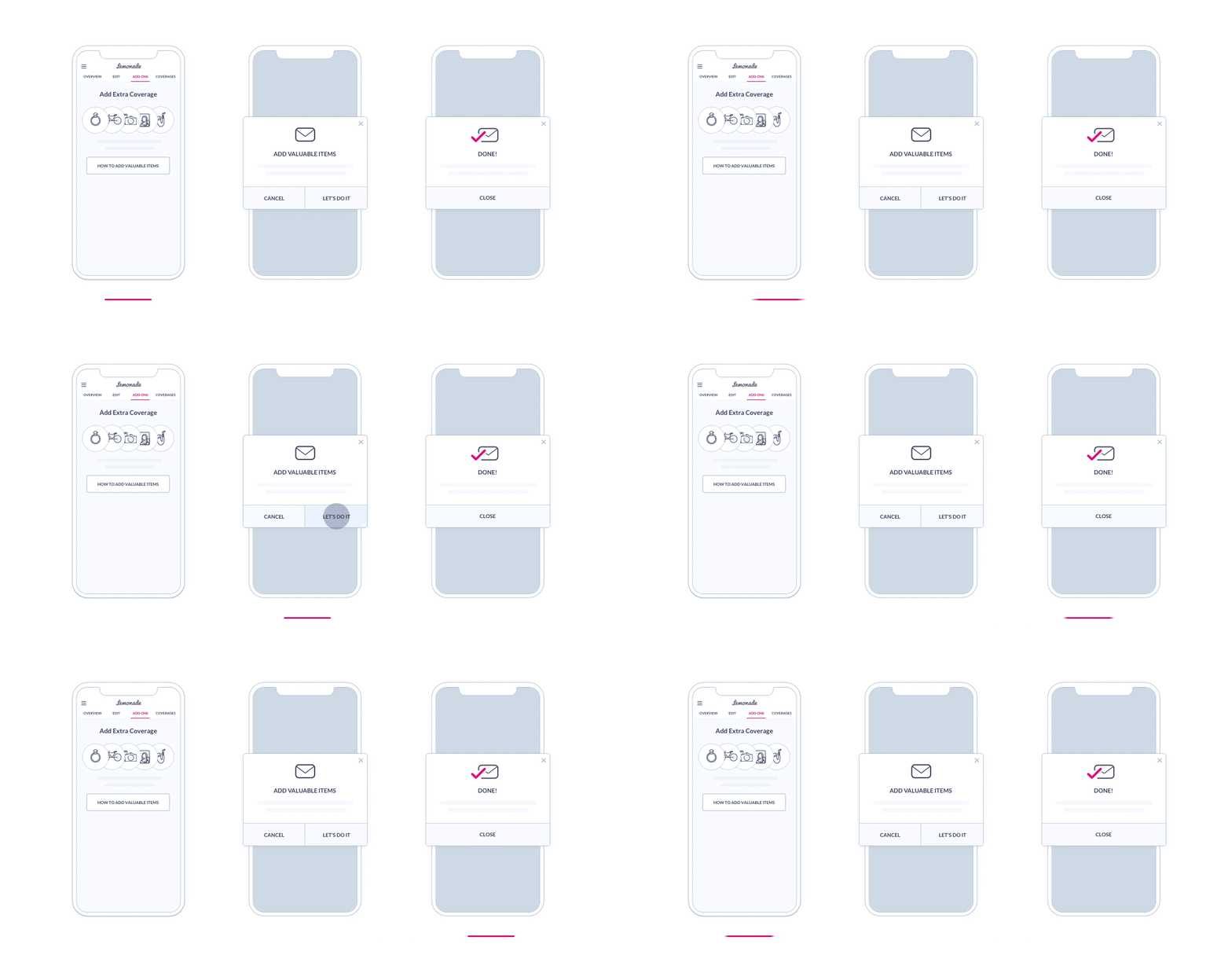
Loss of Use coverage is generally set at around 30 percent of your Coverage A. So, if your dwelling coverage is $300,000, your loss of use coverage should be somewhere between $90,000 to $120,000.
Your Personal Liability coverage kicks in if you cause bodily injury or property damage to someone else or their property. The incident could take place in your home or anywhere else.
The amount of personal liability protection should also take into account the value of your financial assets, which includes your home (and other properties you own), retirement accounts, and investments.
Besides legal fees, your insurer is covering your assets as a whole. The maximum amount of personal liability coverage offered by Lemonade is $500,000-if this isn’t sufficient for you, consider adding an umbrella policy to bring you to $1M in coverage (except in California, where you’re maxxed out at $500k).
Medical expense coverage covers costs related to injuries that take place on your property. In other words, this coverage helps pay for things like an ER visit to set a broken leg after an accident.
You can set this coverage between $1,000 and $5,000. If you’re often hosting parties and social events, it might make sense to opt for the higher end of the range.
| Coverage | Default limit | Minimum | Maximum | Notes |
|---|---|---|---|---|
| Coverage A (Dwelling) | 100% of the home’s estimated rebuild cost* | $125,000** | $1,500,000 | Lemonade recalculates your reconstruction cost estimate each year and will flag if it needs adjusting |
| Coverage B (Other Structures) | 10% of Dwelling | $12,500 (10% of Dwelling) | $150,000 (10% of Dwelling) | In some states you can increase this up to 30% of Coverage A for high-value garages, pool houses, or workshops |
| Coverage C (Personal Property) | 50% of Dwelling | $50,000 (40% of Dwelling) | $850,000 (Default Limit + $100,000) | For high-value items like jewelry, cameras, or bikes, add Extra Coverage to avoid sub-limits |
| Coverage D (Loss of Use) | 30% of Dwelling | $37,500 (Default Limit) | $450,000 (Greater of Default Limit or $200,000) | Covers additional living costs while your home is being repaired: hotel, meals above normal spend, laundry, parking |
| Coverage E (Personal Liability) | $100,000 | $100,000 | $1,000,000*** | For additional protection, consider an umbrella policy to bring your total to $1M (not available in CA, where the cap is $500,000) |
| Coverage F (Medical Payments to Others) | $1,000 | $1,000 | $5,000 | No fault determination needed. Covers guest injuries on your property regardless of who caused them |
Lemonade’s Live Policy allows customers to update their own coverage, whenever and wherever, all on the Lemonade app. You can update your policy to reflect your needs instantly, with no brokers or paperwork involved.
In general, if you want an easy way to eyeball what your current coverages are, you can also take a look at your declarations page, which summarizes the main details.
By all means, when shopping for homeowners insurance, get a number of quotes, compare your options, and make a measured decision.
It’d be kind of weird, though, if we didn’t stand behind Lemonade Homeowners as a terrific option for those interested in 21st-century insurance. The entire experience-from signing up to filing a claim-is all done through our seamless, intuitive app.
Lemonade is built around a simple idea: insurance should take care of people when they need it most, and do some good along the way.
Giveback is at the heart of how Lemonade works. When you get your first policy, you choose a cause you care about, and Lemonade donates to nonprofits supporting those causes. More customers choosing a cause means larger donations to nonprofits supporting it.
Knowing that your insurance connects to causes people care about helps align everyone around honesty and fairness, especially at claims time.
Here are five key factors that can determine how much your Lemonade homeowners insurance premiums will cost:
Rates vary dramatically depending on where you live. Here’s how the most and least expensive states stack up, and why the gap between them is bigger than ever.
Where you live is one of the biggest factors in what you’ll pay for homeowners insurance. Here’s how the most and least expensive states compare.
Highest Premium States
States most vulnerable to severe weather, hurricanes, tornadoes, and hail – dominate the top of the list.
Lowest Premium States
States with the lowest rates generally have milder weather, less frequent catastrophic events, and lower reconstruction costs.
*Standard Hawaii policies exclude hurricane coverage. A separate wind/hurricane policy is needed for full protection.
Pricing gets pretty granular. Not only will your state impact your insurance premium, but your exact address will, too.
For instance, if your home is close to a Class 1 fire department, your premiums might be lower than if you live half an hour from the nearest fire station. Similarly, if you live in a place with a lower crime rate, premiums are likely to be lower than in an area with more crime (this makes sense, considering that theft and vandalism are covered perils).
The state of your home itself will impact your home insurance premium.
Ask yourself these questions:
That pre-war crown molding may be your favorite thing about your home, but are the pipes as old as the ceiling? That could be bad news come winter. Basically, the older your house is, the more prone it is to damage-which is why the older the home, the higher the premium.
An insurance deductible is the amount you choose to be liable for in any future claims payouts. For example, if a tree fell on your roof and caused $20,000 in damage, and your policy has a $1,200 deductible, you’d pay $1,200, and the insurance company would pay the remaining $18,800 (provided your claim was accepted).
Choosing your deductible: what the tradeoff actually looks like
| Deductible | You pay (on a $5,000 claim) | Insurer pays (on a $5,000 claim) | You pay (on a $25,000 claim) | Insurer pays (on a $25,000 claim) |
|---|---|---|---|---|
| $500 | $500 | $4,500 | $500 | $24,500 |
| $1,000 | $1,000 | $4,000 | $1,000 | $24,000 |
| $2,500 | $2,500 | $2,500 | $2,500 | $22,500 |
| $5,000 | $5,000 | $0 | $5,000 | $20,000 |
A higher deductible lowers your monthly premium, but raises what you’d owe out of pocket in a claim. If a $2,500 surprise expense would be a problem, don’t set your deductible there.
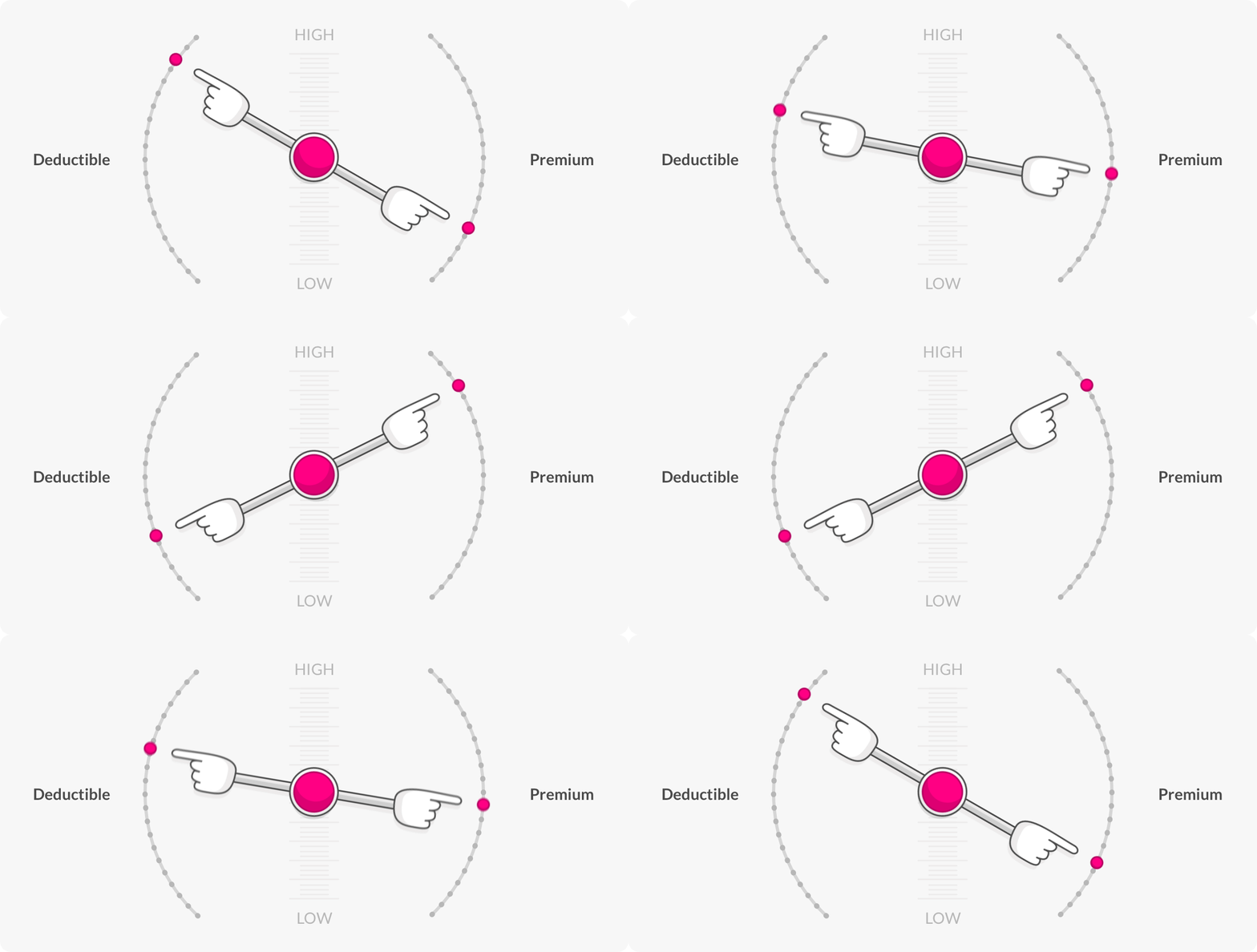
The higher your deductible is, the lower your premium could be.
Keep in mind, however, that a high deductible also means you’ll pay a lot more out-of-pocket in the event of a claim. Different people have different preferences. Would you rather pay more up front, and potentially less down the line in the event of a catastrophe? Or pay less month-to-month, and hope that you don’t have to file any big claims?
If you choose a high deductible and lower premium, and that tree doesn’t fall on your house-well, you’ve come out ahead. But predicting the future is pretty tough.
There’s no right or wrong answer. At the end of the day, choose what makes sense for you.
We’ve already discussed how much coverage you likely need for each of the main six coverage categories, but it bears repeating: The amount of coverage you choose has a direct impact on how much you’ll pay on your monthly premiums. For example, if your dwelling coverage is $300,000, your monthly premiums will probably be lower than if your dwelling coverage is $500,000.
Unlike car insurance, which is required by law if you drive, homeowners insurance is not required simply by virtue of the fact that you’re a homeowner. However most mortgage lenders will require at least some basic form of homeowners insurance. And unless you bought your house with cash, you probably have a mortgage.
Think of it this way: your mortgage lender is essentially a joint homeowner, until you’ve paid off your loan. It’s in their best interest to keep your home in tip-top shape.
Your mortgage lender wants to make sure that if the worst happens to your home, you’ll have the coverage and funds to take care of it. If you don’t, you’d both lose your valuable asset.
Well, you can always go ahead and get your free, fast quote for Lemonade Homeowners by clicking the button below.
Three things matter most. First, dwelling coverage that actually replaces your home at today’s construction costs – not market value, not what you paid. Second, liability limits that at least match your net worth, since judgements from lawsuits can exceed it and you want as much of a buffer as possible. Third, an insurer that handles claims quickly and fairly, because the cheapest policy becomes the most expensive one if they fight every claim. At Lemonade, claims are filed through the app, many can move quickly, and pricing is transparent so you have a clear picture of your coverage before anything goes wrong. Read the full thread on Reddit
If you have a mortgage, it’s not optional. Lenders require you to buy and maintain insurance to protect their investment, and letting a policy lapse can trigger serious financial penalties. But even without a mortgage, skipping homeowners insurance means one fire, one major storm, or one lawsuit from a visitor who gets hurt on your property could financially wipe you out. Your home is likely your largest asset. Replacing it and everything in it out of pocket isn’t realistic for most people. At Lemonade, you can get covered in minutes. For most homeowners, going without it simply isn’t worth the risk. Read the full thread on Reddit
Before closing. Lenders require proof of insurance before funding a mortgage, and you need coverage in place at the moment of purchase. Start shopping early in your home buying process — quotes can take several days to get approved, so don’t wait until the last minute. At Lemonade, you can get a quote quickly and set up a policy in time for closing, with your declarations page available for your lender once approved. Already own a home with no coverage? The best time was before closing. The second best time is right now. Read the full thread on Reddit
A few quick words, because we <3 our lawyers: This post is general in nature, and any statement in it doesn’t alter the terms, conditions, exclusions, or limitations of the policies issued, which differ according to your state of residence. You’re encouraged to discuss your specific circumstances with your own professional advisors. The purpose of this post is merely to provide you with info and insights you can use to make such discussions more productive! Naturally, all comments by, or references to, third parties represent their own views, and Lemonade assumes no responsibility for them. Coverage may not be available in all states. Please note that statements about coverages, policy management, claims processes, Giveback, and customer support apply to policies underwritten by Lemonade Insurance Company or Metromile Insurance Company, a Lemonade company, sold by Lemonade Insurance Agency, LLC. The statements do not apply to policies underwritten by other carriers. Source: Bankrate, “Home Insurance Rates by State for 2026,” data provided by Quadrant Information Services (rates refreshed November 2025). Based on $300,000 in dwelling coverage and a $1,000 deductible. Rates are averages and will vary based on your home, location, and coverage choices.
Please note: Lemonade articles and other editorial content are meant for educational purposes only, and should not be relied upon instead of professional legal, insurance or financial advice. The content of these educational articles does not alter the terms, conditions, exclusions, or limitations of policies issued by Lemonade, which differ according to your state of residence. While we regularly review previously published content to ensure it is accurate and up-to-date, there may be instances in which legal conditions or policy details have changed since publication. Any hypothetical examples used in Lemonade editorial content are purely expositional. Hypothetical examples do not alter or bind Lemonade to any application of your insurance policy to the particular facts and circumstances of any actual claim.